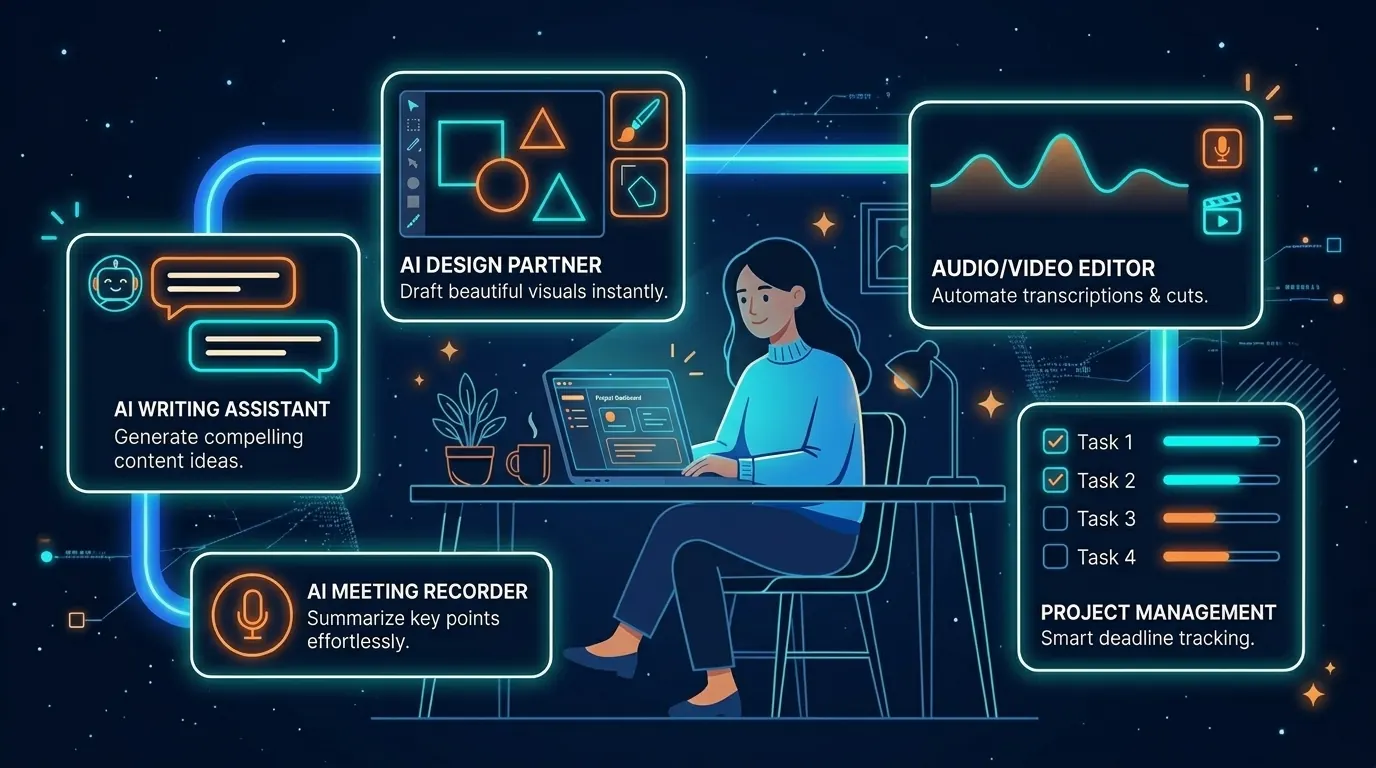
Most articles about AI tools for freelancers are really articles about AI tools in general, with "for freelancers" bolted on at the end of each paragraph.
This one is different. Every tool on this list is here because of what it does specifically for freelancers: winning proposals, delivering work faster, communicating better with clients, managing projects without chaos, and generally running a tighter business.
I have been through enough tools to know which ones earn their place in a real freelance workflow and which ones are impressive demos that do not survive contact with actual client work.
Here are the 10 that made the cut, updated for July 2026.
1. ChatGPT: the core tool every freelancer needs
Free tier: yes, GPT-5 with daily limits, no credit card required. Paid tier: $20 per month (Plus). Higher limits, image generation, memory, and more.
If you only use one AI tool as a freelancer, make it this one.
ChatGPT handles the full range of tasks that eat into a freelancer's day: writing first drafts, crafting client proposals, customizing pitch emails, researching topics before a project, explaining something complex in plain language for a client, drafting invoices and scope documents, and debugging code.
The use case that surprises most people is proposal writing. A good proposal takes time. Understanding the brief, structuring an argument for why you are the right hire, anticipating objections, getting the tone right. ChatGPT cuts that time dramatically:
"Write a freelance proposal for a content writing project. The client needs 4 blog posts per month for a B2B SaaS company selling HR software. I charge $250 per post. Position me as a specialist, not a generalist. Address timeline, process, and why quality matters. Confident but not pushy tone."
That gets you a solid first draft in 30 seconds. You edit it, add your specific experience, make it sound like you, and it is done in 10 minutes instead of 45.
The same principle applies to client onboarding emails, project scope documents, feedback responses, and LinkedIn messages to prospective clients.
What the free tier does not give you: unlimited usage (you will hit caps if using it heavily every day), image generation, and access to GPT-5's most advanced reasoning. For most freelancers starting out, the free tier is enough.
Try ChatGPT. Full review: ChatGPT Plus review.
2. Claude: best for long-form writing and analysis
Free tier: yes, with daily limits and no credit card required. Anthropic does not publish which model the free tier serves and rotates it as new ones ship, so check inside the app rather than trusting any article that names a version. Paid tier: $20 per month (Pro).
Claude is Anthropic's AI assistant and, for freelancers whose primary output is written content, it often outperforms ChatGPT on quality. Read the full Claude review.
The practical advantage is its 200,000 token context window. You can paste an entire research brief, a long client document, or a full draft and Claude processes all of it at once without losing track. For freelancers who work with long-form content (in-depth articles, white papers, case studies, technical documentation) this is a real workflow difference.
The writing quality is also slightly more natural than ChatGPT's default output. Less corporate, less listicle-heavy, more likely to produce prose that does not require heavy editing to sound like a human wrote it.
Specific freelancer use cases where Claude excels:
- Rewriting a client's rough notes into polished copy.
- Summarizing lengthy client briefs into a clear action plan.
- Writing detailed case studies from bullet-point notes.
- Producing first drafts of white papers or industry reports.
- Code review and refactoring for developer freelancers.
Like ChatGPT, the free tier has daily limits. If you are writing professionally every day, you will likely want at least one of these on a paid plan.
Try Claude. For a full breakdown of which tool wins at what, read the Claude vs ChatGPT comparison.
3. Grammarly: best for every client-facing word you write
Free tier: yes, grammar, spelling, punctuation, basic clarity suggestions. Paid tier: around $12 per month (Premium, varies by billing period).
Install Grammarly as a browser extension and it runs silently in the background inside Gmail, Google Docs, LinkedIn, Upwork, your project management tools, anywhere you type on the web.
For freelancers, the value is simple: every word a client reads from you is a sample of your work. A typo in a proposal, a clunky sentence in a project update, a grammatical error in a LinkedIn connection request. These things erode trust before a client has seen a single deliverable.
Grammarly's free tier catches grammar, spelling, punctuation, and basic clarity issues. That is enough for most freelancers. The Premium tier adds AI-powered rewriting, tone suggestions, vocabulary enhancement, and most valuably for writers, plagiarism detection against published content. The plagiarism checker is worth the Premium price on its own if you are producing content professionally and want to verify your AI-assisted drafts before delivery.
It catches errors your own tired eyes miss at 11pm before a deadline. That alone makes it a non-negotiable in a professional freelance setup.
Try Grammarly. Full review: Grammarly review 2026.
4. Canva AI: best for visual deliverables without a design budget
Free tier: yes, includes AI features. Also free via Canva for Education. Paid tier: $15 per month (Pro).
Not every freelancer is a designer, but almost every freelancer eventually needs design work. Proposals with graphics, social media content for clients, portfolio pages, pitch decks, case study documents, branded reports.
Canva's AI features make this manageable without design skills:
Magic Media generates images and videos from text prompts directly inside your Canva designs. Magic Write drafts text for any element. Background Remover isolates subjects from photos instantly. Magic Resize reformats a design for every platform size in one click.
For freelancers specifically, the most useful feature is the Brand Kit in Canva Pro. You upload a client's logo, set their colors and fonts, and every piece of content you create for them is on-brand automatically. This is a time-saver that looks professional to clients who care about visual consistency.
The free tier is substantial. You can create polished client deliverables without paying. The Pro upgrade becomes worth it when you are managing multiple client brands at once.
5. Notion AI: best for running your freelance business systematically
Free tier: Notion app is free, with a small one-time batch of complimentary AI responses. Paid tier: Business at $20 per member per month, which is now the only way to get full AI access.
Notion is a notes and project management tool. Notion AI turns it into a searchable, conversational version of your entire business brain.
Important pricing change: Notion retired the standalone $10 AI add-on and moved full AI access into the Business tier. You can no longer add AI to a cheaper plan, so the real cost for a solo freelancer is $20 per member per month rather than the $10 most guides still quote. I broke down what that actually buys, plus the separate credit charges for Custom Agents, in the full Notion AI review.
The setup that works for most freelancers: a Notion workspace with a client database, a project tracker, a knowledge base of your processes, and a notes section for every active engagement. Notion AI then lets you:
- Summarize meeting notes into a clear action list in one click.
- Ask questions across your entire workspace like "What did I promise the client from Project X last week?" and get an answer pulled from your notes.
- Generate first drafts of client-facing documents directly inside Notion.
- Create SOPs (standard operating procedures) for your recurring processes so you stop reinventing the wheel.
The honest caveat: Notion has a learning curve. If you are starting from scratch, you will spend a few hours setting up a workspace before Notion AI becomes genuinely useful. That investment pays back over months of smoother project management, but it is not instant value.
For freelancers already paying for Notion Business, the AI is included and worth turning on today. If you are on the free plan or Plus, weigh the jump to $20 per member carefully, because you are buying a whole workspace tier to get it.
6. Otter.ai: best for client call transcription
Free tier: yes, 300 minutes transcription per month, 3 audio/video imports. Paid tier: $16.99 per month (Pro).
Freelancers who take client calls (discovery calls, briefing sessions, feedback reviews, check-ins) spend significant time after each call trying to remember exactly what was said and what was agreed.
Otter.ai solves this. It joins your call (or you run it on your phone), transcribes everything in real time with speaker labels, and gives you a searchable, shareable text record of the entire conversation. The AI then generates a summary and highlights action items automatically.
The practical benefits:
- You can focus fully on the conversation instead of taking frantic notes.
- You have a written record if a client later disputes what was agreed.
- Action items are auto-extracted so nothing falls through the cracks.
- You can share the transcript with a client who missed the call or wants a written record.
The free tier's 300 minutes per month covers roughly five one-hour calls. For most freelancers on a moderate schedule, that is enough. Heavy users (anyone with daily calls) will need Pro.
Works on Zoom, Google Meet, Microsoft Teams, and in-person (using the mobile app).
7. Loom: best for async client communication
Free tier: yes, unlimited recordings up to 5 minutes, 25 videos stored. Paid tier: $12.50 per month (Business) with AI summaries, unlimited storage, filler word removal.
The single most underrated tool in a freelancer's communication toolkit.
Loom lets you record your screen and camera at the same time and share the video via a link. No file transfer, no upload to YouTube, just a link that plays instantly. The AI features (on the paid tier) generate an automatic summary, chapter markers, and can remove filler words from your recordings.
For freelancers, the use cases are immediately obvious once you start:
Client walkthroughs. Instead of writing a 500-word email trying to explain changes you made to a website or document, record a 2-minute video walking through it. The client sees exactly what you did and why. This cuts back-and-forth significantly.
Pitches and proposals. Record a 90-second personal video explaining your proposal before a client reads it. Almost no freelancer does this, and it makes you immediately more memorable than the five other proposals they received as PDFs.
Async feedback requests. Show your client a draft, explain your thinking, and ask specific questions all in a 3-minute video. You get more useful feedback faster because the client understands context they would have missed in text alone.
The free tier's 5-minute limit per video is enough for most communication use cases. The Business tier is worth it if you are regularly recording longer walkthroughs.
8. Descript: best for video and podcast freelancers
Free tier: yes, 1 hour transcription per month, watermark on video exports. Paid tier: $12 per month (Creator) with 10 hours per month and no watermark.
If your freelance work involves video editing, podcast production, or any audio/video content, Descript is the tool that changes how long this work takes.
The core concept is unusual but powerful. Descript transcribes your video or audio file, then lets you edit the media by editing the text transcript. Delete a sentence from the transcript and the corresponding audio and video are removed automatically. This is genuinely faster than traditional timeline editing for interview-style content.
The AI features that matter most for freelancers:
Filler word removal. Descript automatically detects and removes every "um," "uh," "you know," and "like" from a recording. For interview-based content this saves hours of manual editing.
Overdub. You can train Descript on a voice sample and use it to fix mistakes. If a speaker misspoke a word, you can correct it by typing the right word and the AI generates the correct speech in that voice. Used ethically (to fix genuine errors in your own recordings or with explicit client permission), this is a significant time saver.
Studio Sound. One click removes background noise and improves audio quality. Useful when clients record themselves on laptops in noisy environments.
For freelancers who produce video or podcast content for clients, Descript competes on quality with tools that cost five times more.
9. GitHub Copilot: best for developer freelancers
Free tier: free for verified students and open source maintainers, otherwise paid. Paid tier: $10 per month (Individual).
If you freelance as a developer (web development, automation, data work, scripting) GitHub Copilot is the most practically valuable AI tool available for your specific work.
Copilot integrates directly into VS Code, JetBrains IDEs, and other editors. As you write code, it suggests completions from the next line to entire function implementations based on the context of your file. It handles repetitive boilerplate, generates implementations from comment descriptions, explains code you are reading, and helps debug errors.
The practical value for freelancers is speed. Tasks that used to take an hour of writing and testing can take 20 minutes. That means you either deliver faster (better client experience) or take on more work at the same quality level (more income).
Important honest note: Copilot is an autocomplete tool, not a replacement for engineering knowledge. It generates plausible code that still needs review. It will occasionally produce code that looks correct and is not. Review everything it suggests, especially anything security-relevant or business-critical.
Alternatives worth knowing: Cursor and Devin Desktop are AI-first code editors that many developers now prefer over Copilot for full agentic coding sessions. Devin Desktop is what Windsurf became after Cognition acquired it, so if you are searching the old name, that is where it went. Both are paid, and both are $20. See how to use Claude AI for coding if you want the Claude-based workflow.
10. Perplexity AI: best for research-heavy freelance work
Free tier: yes, unlimited basic searches, 5 Pro searches per day. Paid tier: $20 per month (Pro).
Freelancers who produce research-heavy content (industry articles, market reports, technical documentation, SEO content) spend significant time finding reliable sources and verifying facts.
Perplexity is an AI search engine that answers questions with cited sources from the real web. Every claim it makes links to a specific source you can verify. For freelancers, this matters because:
You need sources for client content. When you write an industry article claiming "the global AI market is expected to reach $X billion by 2030," your client wants a credible source for that figure. Perplexity surfaces the source alongside the answer.
It is faster than Google for complex research questions. Instead of opening 12 browser tabs and reading through each one, you ask Perplexity and get a synthesized answer with sources in one response.
It stays current. Perplexity always queries the live web, so you are not getting information that is two years out of date. A real problem with general AI tools that run on fixed training data.
Use it at the start of every research-heavy project to build a quick map of the topic, key statistics, and main sources. Then go deeper into the actual sources for anything you will publish. See the Perplexity AI review for the full workflow.
Honorable mentions
Two more tools worth knowing about even if they did not make the top 10.
Zapier with AI Actions. For freelancers running automations between client systems (CRM, invoicing, project management), Zapier plus AI turns tedious multi-step processes into workflows that run automatically. Free tier for low volume, paid from $19.99 per month for real use.
Superhuman AI. Paid email client at $30 per month. For freelancers whose inbox is a huge portion of their workday, cutting email time in half is worth the price. Alternatives include Shortwave and Spark.
The full picture
| Tool | Best for | Free tier | Paid plan |
|---|---|---|---|
| ChatGPT | Proposals, content, all-round | Yes (limits) | $20 per month |
| Claude | Long-form writing, analysis | Yes (limits) | $20 per month |
| Grammarly | All client-facing writing | Yes (core features) | around $12 per month |
| Canva AI | Visual deliverables, design | Yes | $15 per month |
| Notion AI | Project and client management | Trial responses only | $20 per member on Business |
| Otter.ai | Client call transcription | Yes (300 min per month) | $16.99 per month |
| Loom | Async client video communication | Yes (5 min per video) | $12.50 per month |
| Descript | Video and podcast editing | Yes (watermark) | $12 per month |
| GitHub Copilot | Developer freelancers | No (paid or student free) | $10 per month |
| Perplexity AI | Research with sources | Yes (5 Pro per day) | $20 per month |
How to build your stack without overspending
The mistake most freelancers make is subscribing to everything at once before they know what they actually need.
Here is how to build a tool stack sensibly.
Start free. Every tool on this list except GitHub Copilot has a usable free tier. Run your freelance workflow for 30 days using only free tiers. Notice which limits you hit repeatedly. Those are the tools worth upgrading.
Your first paid upgrade should be wherever you lose the most time. If you are constantly hitting ChatGPT's daily limits, Plus is worth $20. If you are embarrassed by typos in client emails, Grammarly Pro at $12 earns its keep. If you are spending hours on video editing, Descript Creator at $12 is a no-brainer.
Do not pay for tools you are not using weekly. A $12 per month tool you open twice a month costs $144 per year for almost nothing.
The core free stack (ChatGPT free tier, Grammarly free, Canva free, Otter.ai free, Loom free, Perplexity free) covers the daily needs of most freelancers at zero cost. Build from there.
For most active freelancers, a realistic paid stack looks like: ChatGPT Plus or Claude Pro at $20 per month, Grammarly Pro at $12 per month billed annually, and one workflow-specific paid tool like Descript, Loom Business, or Notion Business. Around $45 to $55 per month total. For a working freelancer, that pays for itself in the first week every month.
Once the stack is set, the harder part is winning the work. How to use ChatGPT for freelancing on Fiverr and Upwork covers proposals, pricing, and the parts of those platforms that punish obvious AI output.
What AI cannot replace for freelancers
The tools above make you faster. They do not make you a better freelancer.
Client relationships are still built by humans. Trust, referrals, repeat business come from being reliable, communicating clearly, and delivering what you promised. AI does not do that for you.
Judgment on what a client actually needs is still human work. Clients often ask for one thing but need another. Reading between the lines and delivering the actual value is why they hire a professional over generating something themselves.
Your positioning, your niche, and your reputation. These take years to build and cannot be shortcut with AI.
Use AI to move faster on the mechanical parts. Spend the time you save on the parts that only you can do.
See also:
- 7 Real Ways to Make Money with AI Tools in 2026. The income models that use these tools.
- 12 Best Free AI Tools You Can Use Right Now. Broader free AI tool coverage beyond the freelancing context.
- Is AI replacing freelancers? The bigger market context.